Scaling AI vs. Customer LTV: When Does Bigger Stop Paying Off?
Overview
Frontier AI development has entered a phase where model quality and training budgets no longer scale linearly. Performance follows predictable scaling laws, but the costs rise exponentially. As organizations push toward larger and more capable models, they must answer a critical strategic question:
"Does additional scaling meaningfully improve performance and justify its cost given our customer lifetime value?
This project investigates that question by combining empirical scaling-law analysis, compute cost estimation, and financial metrics to evaluate when scaling is technically beneficial — and when it becomes financially counterproductive.
What This Project Does
This project walks through four pillars:
1. Scaling Law Evaluation:
- loss vs. model size
- loss vs. compute
- diminishing returns inflection points
This reveals the true marginal benefit of additional scaling.
2. Compute & Cost Modeling
I estimate:
- the compute required to reach the diminishing-return region
- approximate capex/opex costs for that scale (GPUs, electricity, training cycles)
This answers “What would this cost in practice?”
3. Customer Life-Time Value Integration
Then I compare scaling costs against:
- subscriber lifetime value (pro tiers and enterprise tiers)
- revenue per user
- payback window and VaR (Value-At-Risk) using Monte Carlo Simulations
- revenue-weighted average LTV
This frames scaling as a business decision, not just a research aspiration.
4. Financial Justification
Using simple metrics like ROI and NPV, the project evaluates whether additional scaling creates value or destroys it. For example, I compute Value at Risk (VaR) and expected shortfall for the investment.
The project evaluates whether additional scaling creates value or destroys it. We also factor in revenue elasticity, modeling how incremental improvements in model performance translate to proportional increases in customer LTV, which directly impacts payback time and overall investment justification.
Why I Built This Project
AI labs today operate at the intersection of:
- machine learning theory
- infrastructure economics
- product monetization
In this project, I show I understand all three. It demonstrates my:
- fluency with the mathematics and empirical behavior of scaling laws
- awareness of the very real costs associated with modern LLM training
- my ability to connect technical decisions to business fundamentals
- operational thinking aligned with how frontier labs evaluate new models
So now that you understand the why, lets dive in. The full notebook can be found [Here].
Hypothetical Project Scenario
A company is training a Llama-like model. They want to determine how much they can scale their AI model before they start to see diminishing returns on investment, and marginal performance improvements as they scale.
Constraints:
- v1 base model with 7B parameters
- Uses Nvidia H100 GPUs
- 100% of the user base consists of pro & enterprise users (cost of free-tier users absorbed by pro tier users)
- Chinchilla scaling law and open-source/named benchmarks for FLOP and cost projections.
- Model industry training and inference with real 2025 H100 pricing and realistic 38-day run targets.
- Customer base: 1.4M active paying users, split 91% Pro (20/mo) and 9% Enterprise (120K/year median ACV).
Results: Diminishing Returns and the Risk Envelope Overview
To answer whether funding the next giant leap in AI model scale (e.g., v3 650B parameters) really pays off, I built a simulation using up-to-date scaling laws, empirical GPU rental costs, and critically, a defensible, segment-weighted customer LTV using revenue-weighted average for total LTV. Here's the visualization of the results:
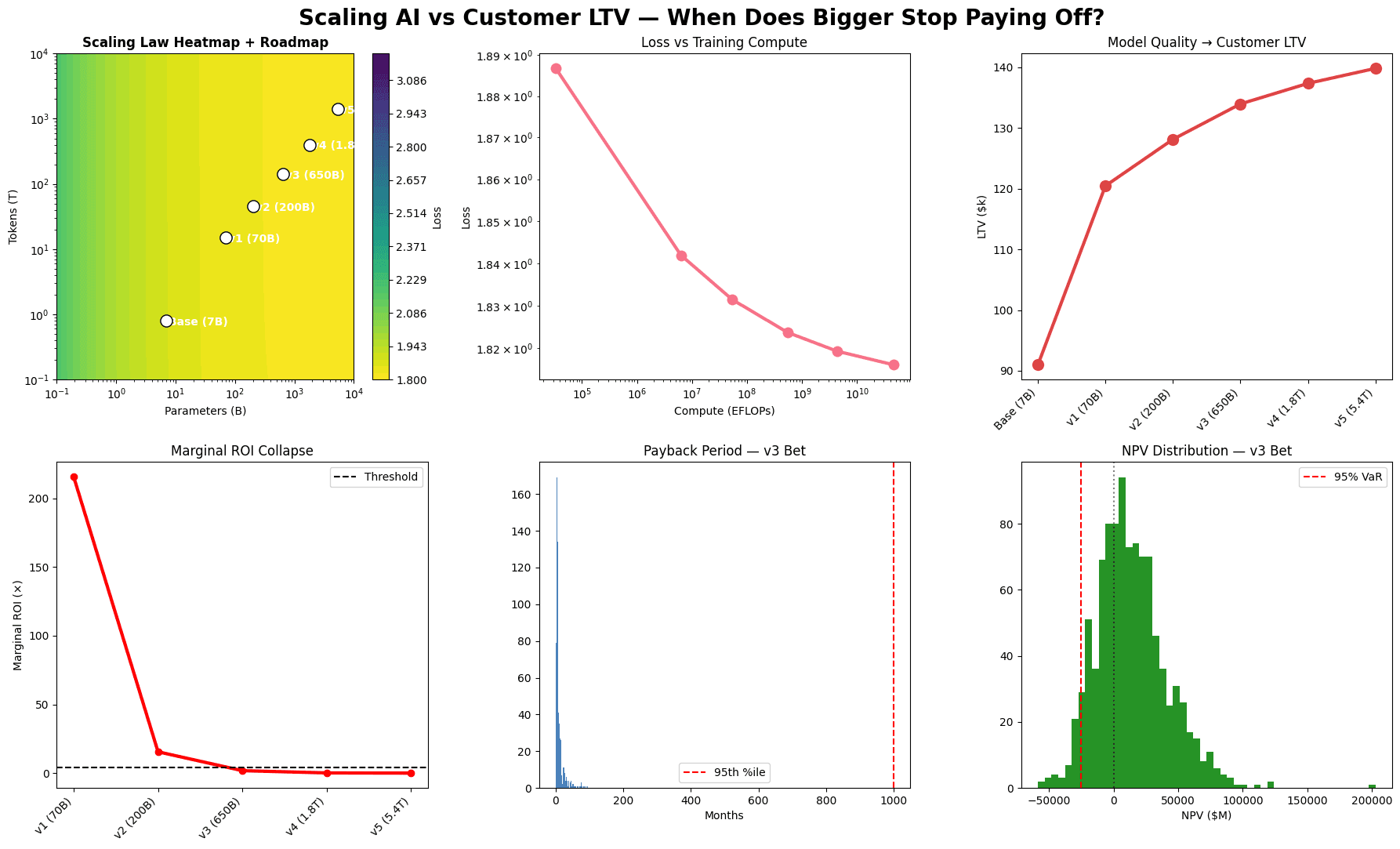
What this means and where the ROI dimishes:
Our roadmap shows clear loss improvements with larger models, but the costs skyrocket exponentially.
- Loss improvement from v1 to v3: ~0.018 (about a ~1% relative reduction)
- Training + 3-year inference costs jump from 110M, up to 4B (nearly 40× increase)
- Loss improvements flatten after v3, from v3 to v5 only a further 0.006 loss drop at 70× cost increase
This essentially means:
- Each model upgrade after v3 produces smaller marginal improvements in loss, which translates to less uplift in customer LTV.
- Investment Cost: The compute and infrastructure cost grows much faster than performance improves (due to cubic or worse scaling in training FLOPS).
Combined, this means the marginal return on each extra dollar invested declines sharply after v3.
Business Implications
- At or below v3, the investment looks justifiable: Marginal ROI is above 4×; the predicted payback (~10 months) and 95% VaR show controlled downside.
- Beyond v3, the ballooning costs outpace the small customer value gains, making deeper scaling economically risky without a fundamental change in business scale or model efficiency.
This sets a natural “economic frontier” for model development where focusing on user acquisition, retention, or alternative optimizations may provide better capital efficiency than simply scaling model size.
Adding Churn Sensitivity: How Retention Drives Payback Periods
A key insight from the sensitivity analysis is how profoundly a seemingly small 1% absolute increase in customer churn elongates the payback period on multi-billion-dollar AI model investments.
For example, in my model:
- The Pro LTV dropped from 500 to 400, reflecting fewer months of subscription revenue.
- The Enterprise LTV halved—from 1.33M to around $571K due to higher churn drastically shortening expected contract lifetimes.
- This caused the median payback on the v3 model to stretch from under 10 months to nearly 29 months, an increase of almost 19 months, significantly impacting capital efficiency and risk.
This tells us a critical truth in AI SaaS economics: customer retention is as vital as technical model quality improvements. Even the best LLM gains must be paired with strong retention strategies to realize their value.
On Retention Rate Dynamics and Model Upgrades
In a fully detailed model, one would also incorporate retention improvements linked dynamically to model upgrades as declining baseline retention rate for the current model typically signals the need to invest in the next frontier model to stay competitive and reduce churn.
However, due to:
- The lack of real-world retention data for different LLM versions,
- Complex feedback loops where churn reductions also indirectly boost upsell and engagement,
I deliberately didn't include retention from the current framework for simplicity. This also isolates the pure effect of model quality-driven LTV elasticity, providing a conservative baseline.
Future reports could integrate real retention, behavioral data, and indirect downstream engagement side effects to project a better ROI baseline.
Summary: Why It Matters for Decision-Makers
Although each new generation of model reduces loss and boosts customer lifetime value, this report reveals that continuing to build bigger models leads to diminishing returns after v3 (650B parameters). The steep rise in GPU and inference costs isn't worth the incremental business value gained.
This helps guide smart capital allocation up to v3, aggressively scaling and innovating makes sense. However beyond v3, careful cost-benefit analysis suggests pivoting toward customer growth and operational improvements and investing in marketing and horizontal expansion to add features instead of blind scaling.
Hasan Ahmed - 2025